postbop
Memories of Postbop
MC Coy Tyner on guitar
a guide to help you to get the sound under your fingers
Introduction
if you want to be able to understand the art form of postbop or contemporary jazz music, you have to understand what came before this kind of jazz music was invented.
The information in this book is based on the information you are getting out of my „Quickguide to creating bebop lines“ book. The playing techniques of bebop give you the skills you need, to extend your musical ideas to the contemporary jazz sound you are looking for.
Bebop was a masterful artform where Players like Dizzie Gillespie, Charlie Parker, and Art Tatum outline the harmonies like detailed sketches.
Mc Coy Tyner and John Coltrane started a new kind of sound era, where the players threw strong colors on the canvas of music and extend or simplify the harmony in many directions to create new strong but also clear outside sounds.
The use of pentatonic, triads, and combinations out of this material, gave them the tools or the vehicle to went so far away or create these new sounds.
In this book, we want to take a look at the most common techniques to get the postbop sound into your playing. Hope you enjoy it!
The Pentatonic Substitution
I think the pentatonic is a good point to start. We all know the pentatonic scale. Major, Minor, Blues, or Dominant Pentatonic are the most used material for this improvisation technique.
We want to start with simple Pentatonic Substitutions. For example, instead of just using a D minor Pentatonic for a D Minor Chord, we want to use another pentatonic to extend the chord.
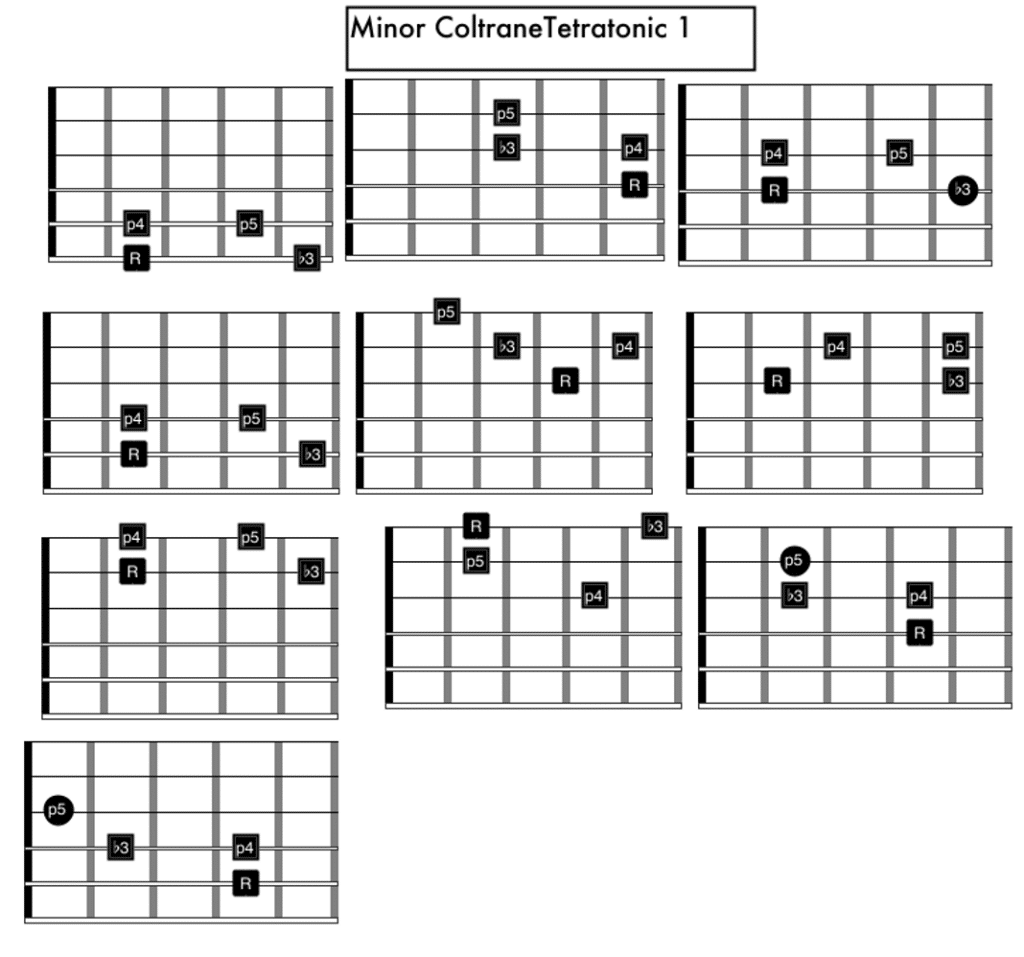
A very great technique to get the Pentatonic sound of MC Coy Tyner or John Coltrane in your playing is to concentrate on 4 note groupings out of the pentatonic and work with their inversions. It helps me if I imagine that a piano player uses mostly 4 Fingers to represent an inversion and move around with them.
Instead of only using one pentatonic scale for each chord, it’s a common idea to work with pairs of pentatonic scales. So it’s a good idea to start with the root pentatonic and extend them with the new pentatonic idea in your playing.
- Try to focus on a string set with 4 notes
- Workout the different inversions of each fingering or string set
For example …
Checkbox
- Choose a good sounding, solid pentatonic for the given chord
- Think in groups of 4 different notes or pattern (Melodic Cell)
- Experiment with all different inversions or permutations of this pattern
- Collect more of this pattern for different areas of the fretboard
Penetatonics for the II degree
Let’s start with some pentatonic substitution ideas for the second degree of a 2-5-1 progression. In this case, we want to use a Dm7 chord as our root chord. Try to alternate the first pentatonic idea with the second pentatonic idea every two beats or from bar to bar.
| Chord | First Pentatonic (stabil) | Second pentatonic | Color notes |
| Dm7 | D Minor PentatonicOr D Minor 6 Pentatonic | A Minor Pentatonic | 9 |
| E Minor Pentatonic | 9, 11 | ||
| G Dominant Penta | 11, 13 |
Pentatonics for the V degree
It’s common to see the 2-5 progression just as a dominant with a provision. The following pentatonic ideas can also be used over the 2nd degree as well if tehe second degree is a part of a 2-5 progression.
| Chord | First Pentatonic (stabil) | Second pentatonic | Color notes |
| G7 | G Dominant Pentatonic | D Minor Pentatonic | 9, 11 |
| Db Major Pentatonic | b9, #9, #11, b13, 11 | ||
| A Minor Pentatonic | 9, 11, 13 | ||
| Ab Major Pentatonic | |||
| Ab Minor | |
Pentatonics for the I degree
I think you got a good idea of the concept of alternating a stabil pentatonic with a more outside or colorful pentatonic. The first degree is a very stabil harmonic. We should choose pentatonics, which really bring them to shine and not to let them seem weird.
| Chord | First Pentatonic (stabil) | Second pentatonic | Color notes |
| Cmaj7 | C Major Pentatonic | E Minor Pentatonic | 9, 13 |
| E Major Dominant Penta (lydian augmented sound) | 9, #11, #5, | ||
Pentatonics for the IV degree
In this case, we see the IV degree as a lydian chord. Lydian chords can also appear in modal tunes or to give more flavor tot he root chord (first degree).
| Chord | First Pentatonic (stabil) | Second pentatonic | Color notes |
| Fmaj7#11 | F Major Pentatonic | E Minor Pentatonic | #11, 13 |
| C Major Pentatonic |
Triad Pairs
The Triad pair system is a far-reaching but thankful topic. If you learned your Major and minor Triads, you are able to combine triads in seemingly endless possiblities to create new „hexatonics“. Hexatonics are 6 note Scales, which you produce when you combine 2 Triads. The trick is to mix them also in a very clear way by changing them in a senseful harmonic rhythmn like for example in half bars.
Triad Pairs for the II degree
| Chord | First Triad (stabil) | Second pentatonic | Color notes |
| Dm7 | F Major Triad | G Major Triad | 9, 11, 13 |
| A Minor Triad | E Minor Triad | 9, 11, 13 | |
| „ | G Major Triad | 9, 11, 13 |
Triad Pairs for the V degree
| Chord | First Triad (stabil) | Second pentatonic | Color notes |
| G7 | G Major Triad | F Major Triad | 9, 11, 13 |
| „ | Db Major Triad | 9, 11, 13 | |
| „ | Db Minor Triad | 9, 11, 13 | |
| „ | Ab Major Triad | ||
| G7alt | Db Major Triad | Eb Major Triad |
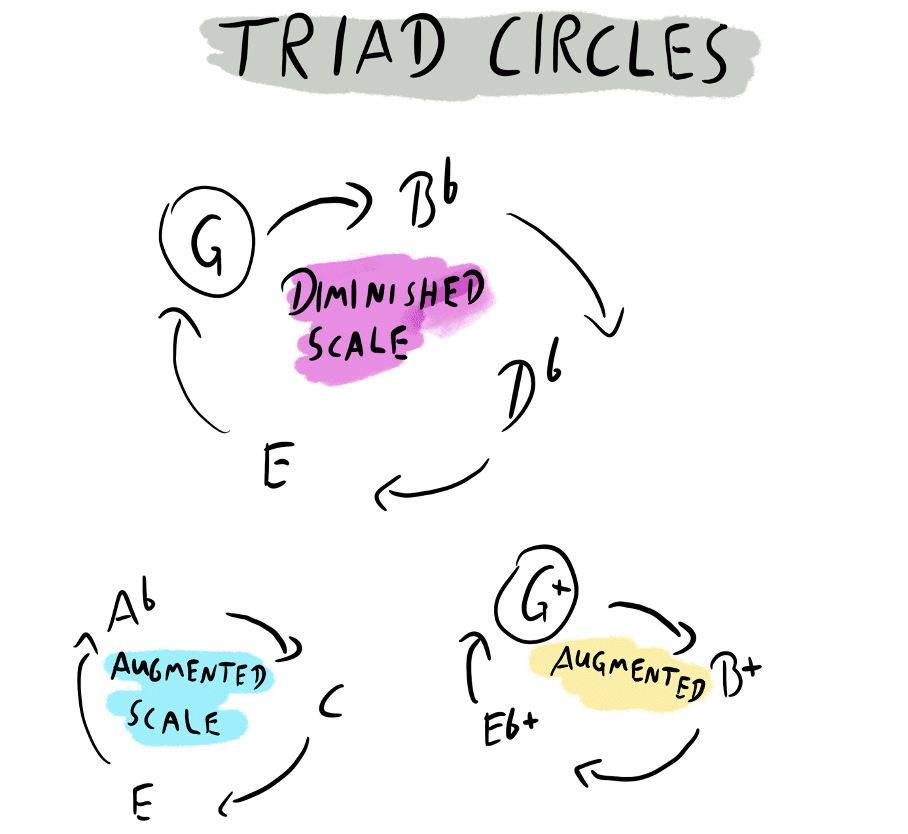
Dominant chords are a big ground for many different possiblies of triad pairs. It’s also possible to find 3 or 4 Triads which build a circle if you see them as a group.
Halfstep Shifting
Pentatonics and triads are very stabil and strong constructions. This attribute is very good if we want to create outside sounds for our improvisations. Modern Jazz Players shifting these shapes in halfsteps to create tension.
If you want, that this concept work for you, it’s very important to alternate stabil and shifted shapes in a clear way belong to the harmonic rhythmn. Try to work with inversions of 4 note patterns also.
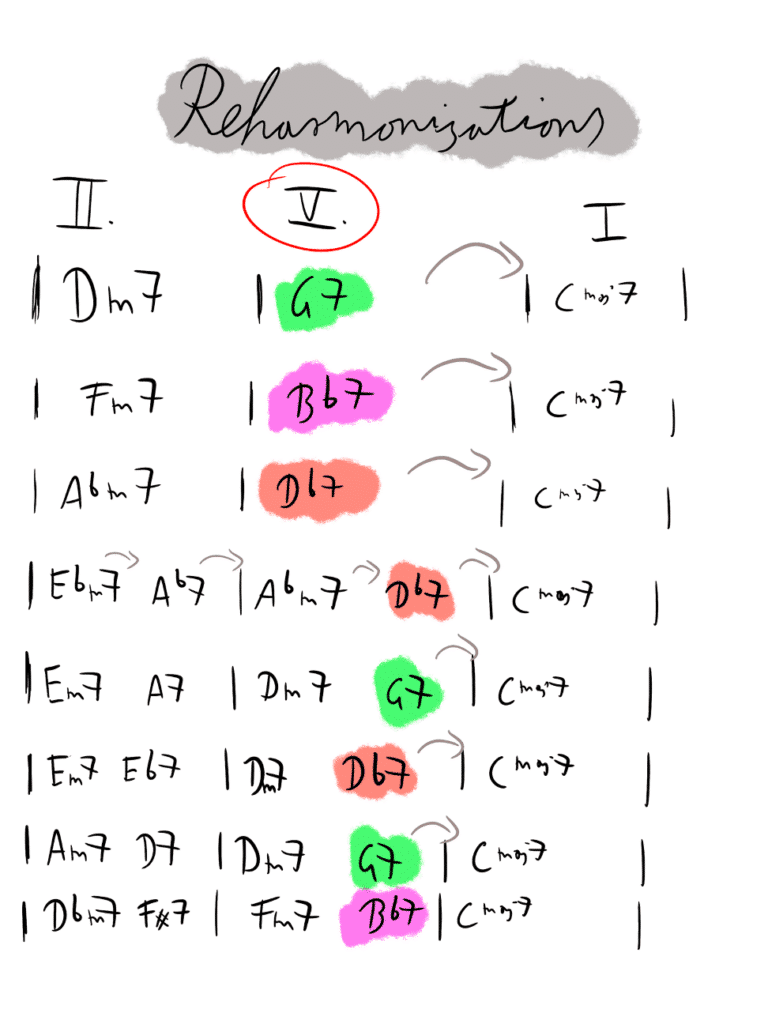
Reharmonizations
The rhythmn group is not the only part in the band which can apply a the harmony in the song. It’s also possible to extend the harmonic foundation by create new reharmonizations while you improvising. This technique can bring fresh and also outside sounds in the improvisation.
The main idea is to substitute the Dominant chord into another chord, which we can drive on with other chord progressions.