comping
Comping
Comping in jazz (accompaniment) is an art form just as important as soloing and improvising. It brings together many different tastes and ideas. Depending on the style you are playing or the musicians you are playing with, the approach to comping can vary greatly.
Here are a few points to keep in mind.
Important factors that influence the style of comping are:
- Formation
- Instrumentation
- Musical style
- Personal preferences
Tools that are important for comping:
- Voicings
- Rhythm
- Tone and attack
- Accents
- Accompaniment lines – counterpoint and bass lines
Formations can range from solo, duo, trio, to a full big band. The instrumentation determines the makeup of your combo. Am I the only harmony instrument? Is there a bass? Who plays the upper and middle voices? These are questions you need to ask yourself to develop appropriate comping.
One of the most important tools available to a guitarist for comping is their guitar voicings. There are countless ways to change or support the sound of a band through voicings. Later in this book, you will learn which comping variations suit different situations and musical styles. The following sections introduce the techniques.
The early big Band Guitar
Our journey begins in the mid-1930s. Swing had become the most popular style of jazz, and despite the Great Depression, the big bands managed to get people in America onto the dance floors to “swing.”
At that time, the guitar did not serve as a solo instrument or “lead voice.” It played a relatively small role as an accompaniment instrument within the rhythm section and almost never stood out in the foreground.
The most famous big band guitarist and pioneer of big band guitar was—and still is—Freddie Green, guitarist of the incredibly successful Count Basie Big Band.
Freddie Green developed a distinctive accompaniment style on the guitar, characterized by subtle, stripped-down harmonies and a percussive, quarter-note-based attack.
He created close, simply constructed chord shapes that are played exclusively on the three bass strings and the G string. These understated voicings provide an ideal accompaniment foundation for blending into the big band texture.
In the following illustration, you can see a maj7 voicing with the root on the low E string, as Freddie Green would likely have played it. It consists solely of the root, third, and seventh. The fifth is omitted to create a more open, uncluttered sound.
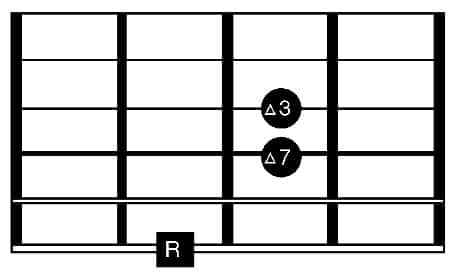
Using our middle finger, we play the root on the low E string. The ring finger plays the seventh on the D string. The pinky is responsible for the third on the G string.
Strum this chord with a downward stroke. Make sure to mute the A string with either your index or ring finger; it should not resonate during the following exercises. Do not strike the B and high E strings.
The strumming
Playing steady quarter notes is a fundamental requirement for timekeeping and a sense of rhythm—not only in jazz, but in all styles of music.
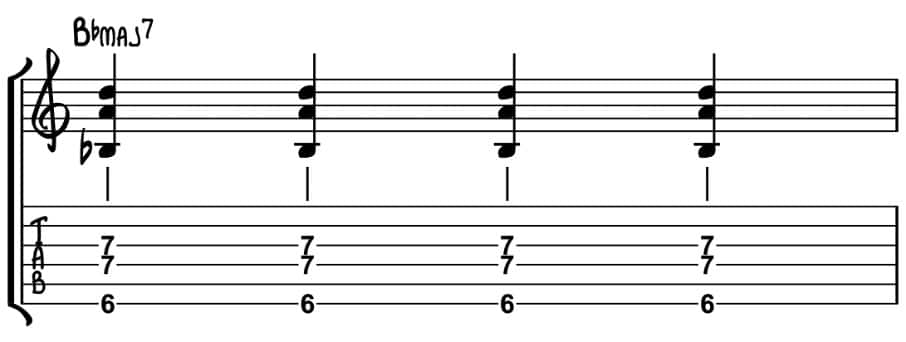
Each stroke should be of equal length and have similar dynamics. This type of accompaniment does not resemble typical big band comping—it lacks accentuation, dynamics, and “swing feel.”
In big band jazz accompaniment, our strokes are executed quickly. The quarter notes are never fully tied. Specifically, this means that the right hand performs fast downward strokes (all the notes should sound as simultaneously as possible). The left hand releases the chord slightly before the next stroke so that each hit is distinct. This simply requires relaxing the pressure of the left hand. When the left hand releases tension, the note stops sounding and prevents the strings from ringing out (left-hand muting technique).
How long or short the quarter notes are held depends on the style. If a piece should sound more relaxed, the quarter notes are held longer and played more softly (often using the thumb).
In terms of dynamics, beats 2 and 4 are emphasized. Accenting beats 2 and 4 is very typical in many jazz styles and should be kept in mind.
With beats 2 and 4 emphasized, we now have a basic rhythmic pattern or a certain “groove.”
To give the picking even more character, so-called “dead notes” can be added. These small details bring the music to life. Dead notes are percussive, muted sounds that do not produce a clear pitch.
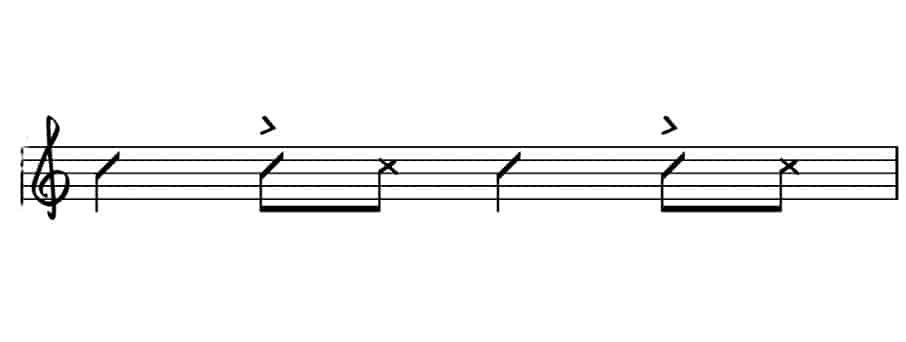
To play dead notes, the left hand touches the strings without pressing them down to the fretboard. No sustained tone should sound.
By observing all these points, we achieve a sound where beats 1 and 3 are broader and longer, while beats 2 and 4 are shorter and more percussive.
Shell-Voicings
Practice the following voicings. It doesn’t matter in which position you play them. Since we do not use open strings, these voicings can be applied anywhere on the fretboard.
Maj7- E- Type
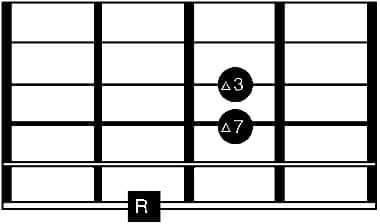
Maj7 – A- Type
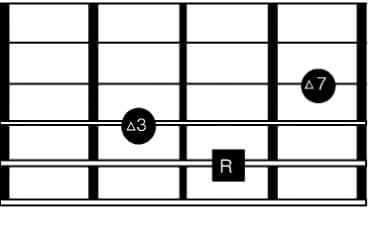
m7 – E Typ
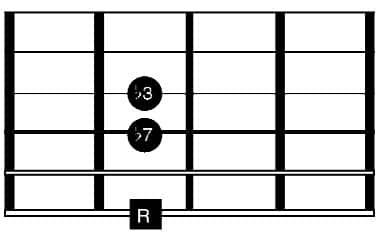
m7 – A Typ
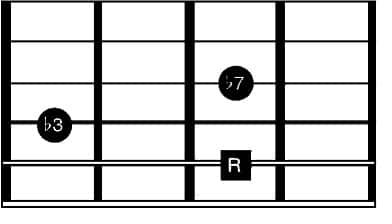
Dominant7 – E Typ
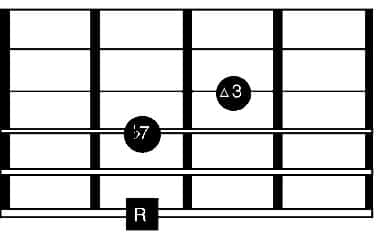
Dominant7 – A Typ
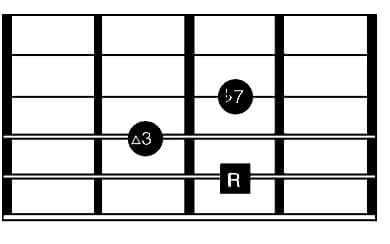
m6 o. vermindert – E Typ
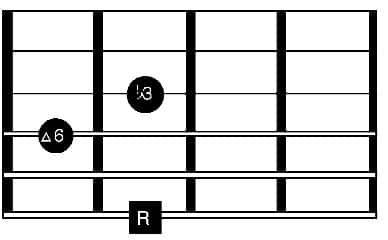
m6 o. vermindert – A Typ
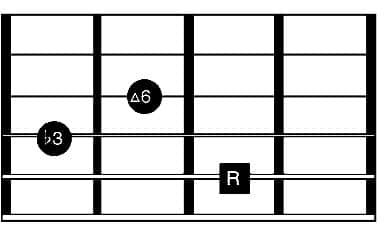
In shell voicings, no fifths are included.
Exercise!
Once you feel that you have internalized the voicings, try practicing chord changes using shell-chord voicings with the following chord progression.
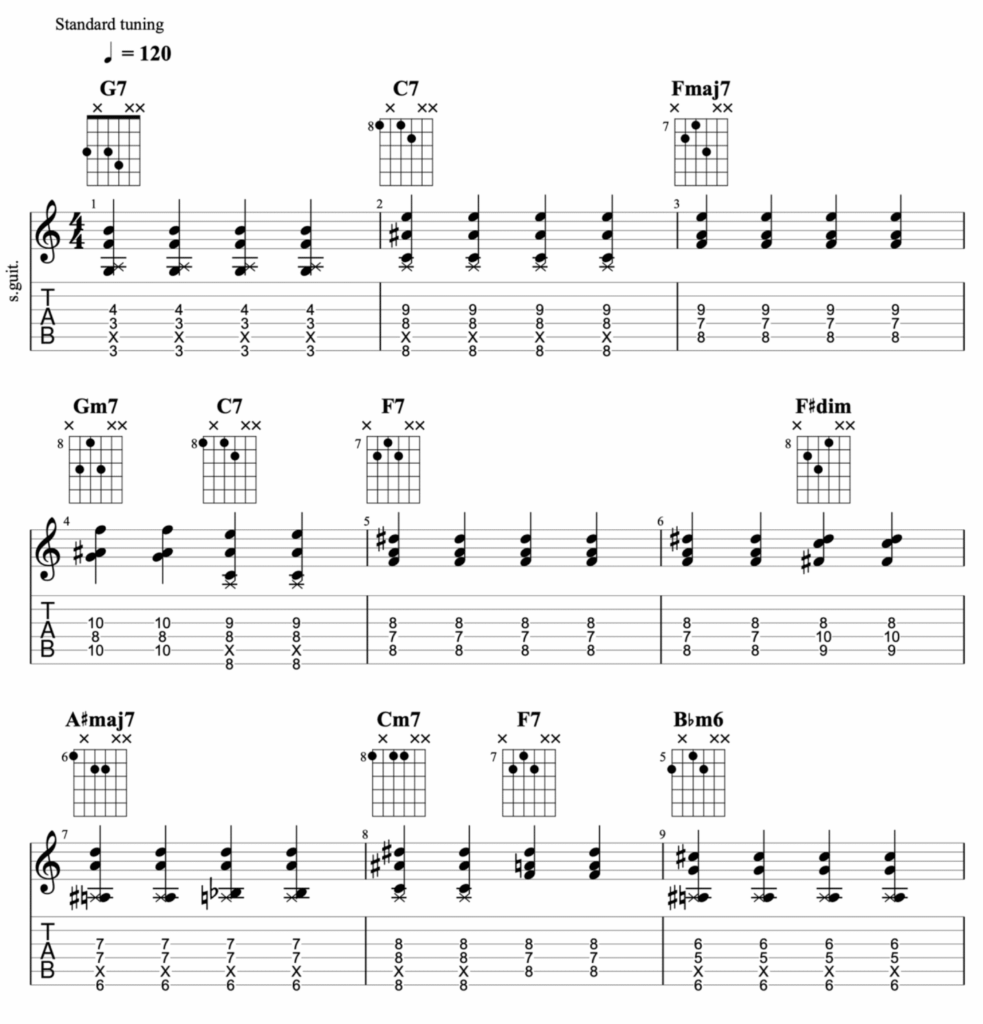
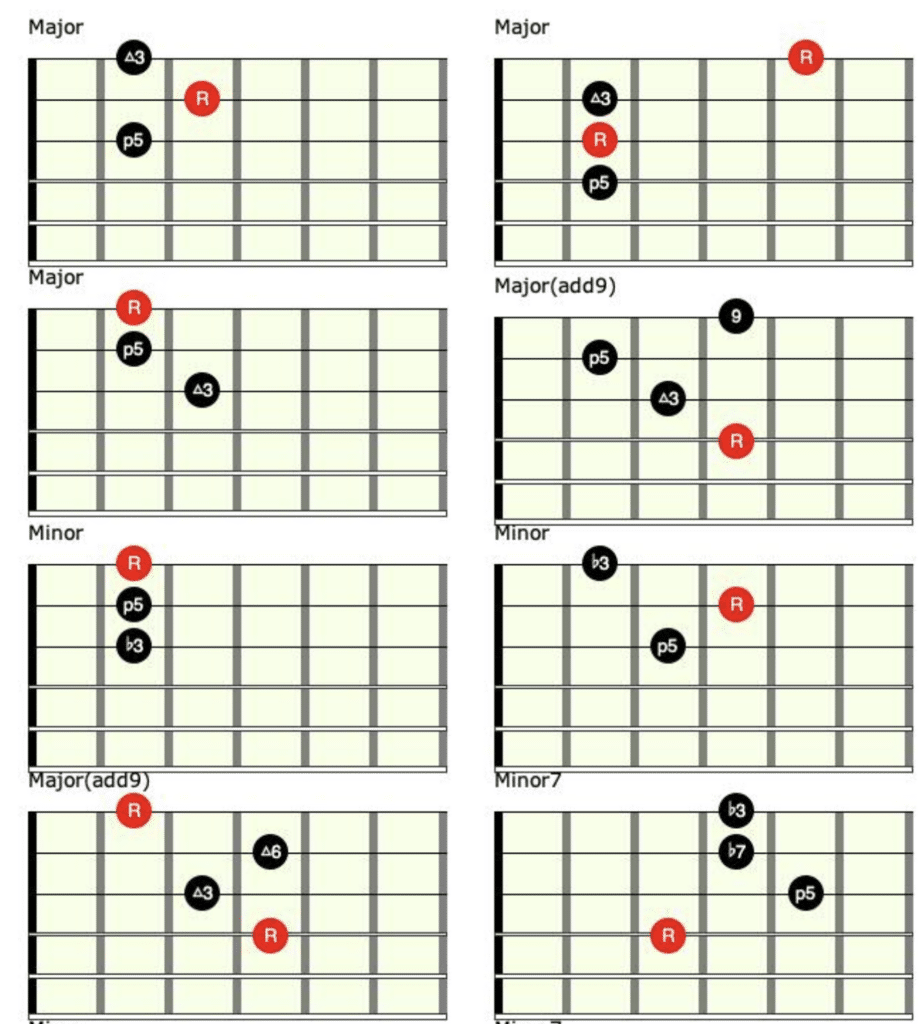
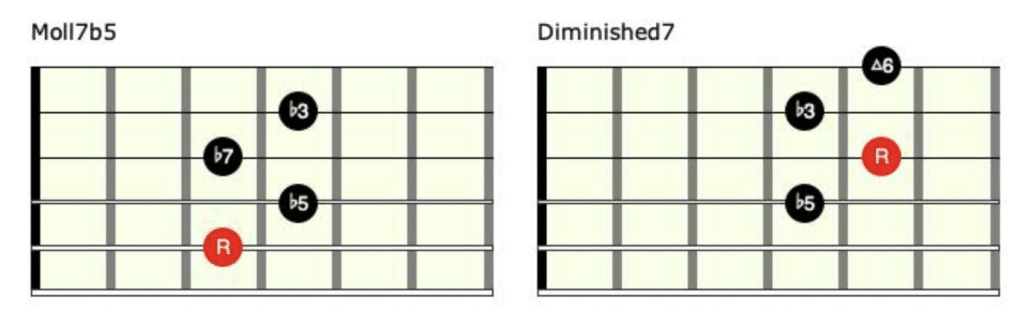
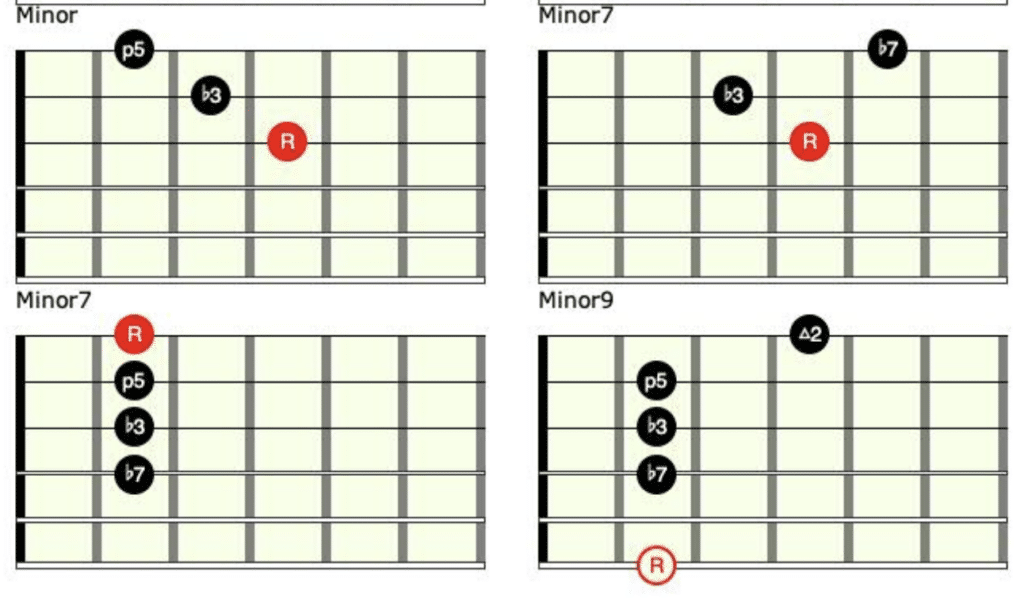
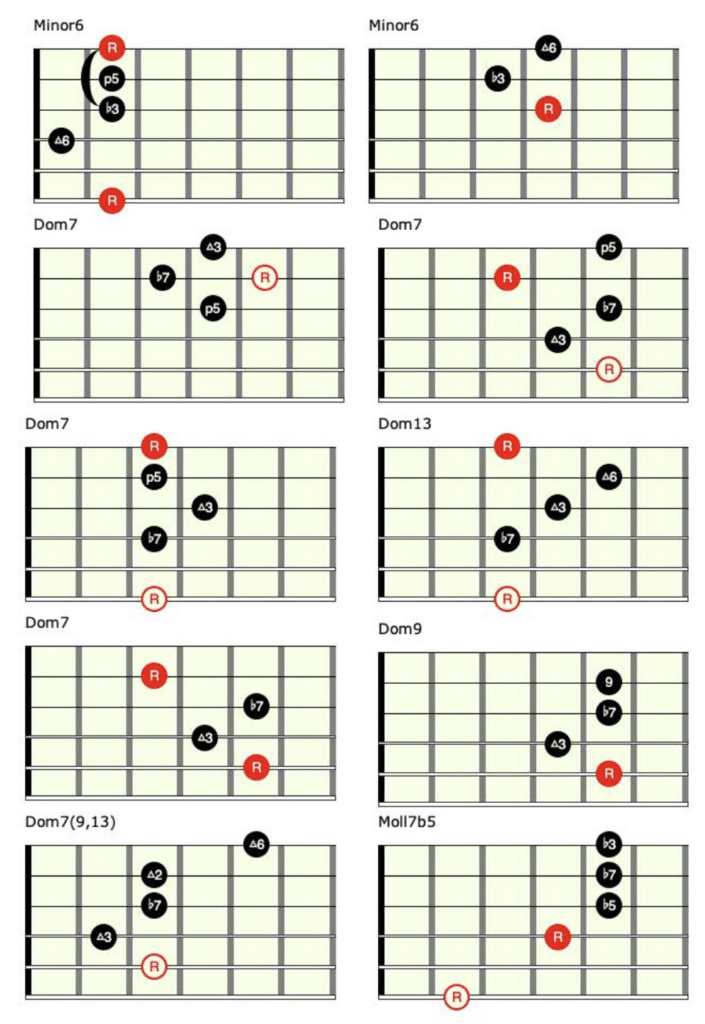
Most common chord shapes
Guitar players like Eddie Lang, Dick Mc Donough, and Carl Kress used
simple inversions of chord shapes to extend the melody notes.
To get a foot in this style, it’s important to learn all inversions of
triads, minor7, dim7, minor7b5 and dominant7 chords all over the
fretboard on the higher string set. I collect some of the most common
shapes for you. After that you can see other shapes which can cross
your way in the world of jazz.
Accompaniment with Bass Function
First, we want to focus on voicings that interact with a bass note.
Voicings that are played exclusively on these string pairs could be shell or big band voicings, which we will cover later in the book. Similarly, the walking bass—although not technically a voicing, but still a form of accompaniment—is usually played only on the bass strings.
As the name suggests, our bass strings are the ideal range for adding a bass sound to a band. They are therefore often essential when there is no bassist in the group. For example, if you are playing with a singer, they will usually want to hear a bass foundation to support them.
In the following example, I created a walking bass line over a 2-5-1 progression. I also enriched it with additional tones from the shell voicings. Typically, the bass is played on the low “E” and “A” strings, while the “D” and “G” strings provide the accents for the mid-range.