palmwine-english
Introduction
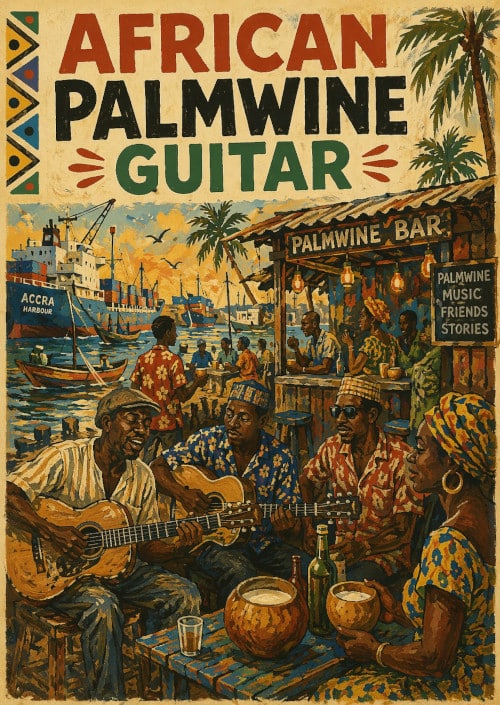
Palmwine music originated on the west coast of Africa, particularly in the port cities of what are now Ghana, Sierra Leone, Liberia, and Nigeria. Around 1900, it was already considered a firmly established part of society.
It is no coincidence that the Palmwine style developed mainly in the coastal regions of Africa. Sailors traveling by sea brought influences from Caribbean and Spanish music to the region, which then blended with local African musical traditions.
The style was quickly named “Palmwine” because it was played in harbor bars, where seafarers would often stop to enjoy a drink.
One of the key pioneers and a father of contemporary Palmwine music is Kwame Asare (also known as Jacob Sam). We will begin by taking a closer look at one of his pieces.
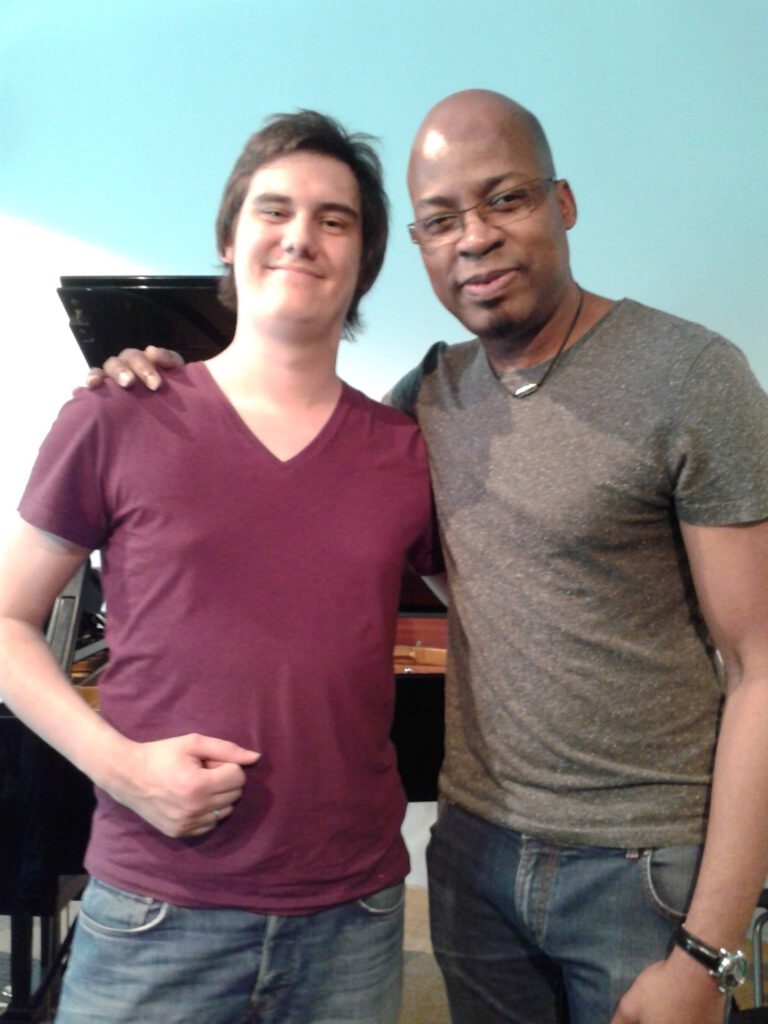
The man to my left is the outstanding West African guitar virtuoso Lionel Loueke. Lionel was the first musician who sparked my curiosity about African musical culture through his guitar skills and his wonderful compositions.
I had the opportunity to meet him in person at a workshop at the Institute of Music in Osnabrück, Germany. I had already been familiar with his music for a few months beforehand, and it opened up a completely new musical dimension for me.
Basic techniques
Palmwine guitar is played almost exclusively on acoustic steel-string or classical guitars—often with a capo, allowing access to higher registers while still maintaining an expressive fingerstyle approach.
Palmwine players typically use just the thumb and one finger (usually the index finger—although in my examples, I use the middle finger of my right hand).
A characteristic stylistic element is the use of thirds and sixth intervals, which are played simultaneously, but also combined with offset rhythms between the thumb and the finger voice.
The music has a flowing, lilting feel and is played in a ternary groove rather than strictly straight—a subtle sixteenth-note swing forms the foundation.
Exploring thirds and sixths in open guitar positions is, in my view, a solid foundation for approaching African
music more broadly.
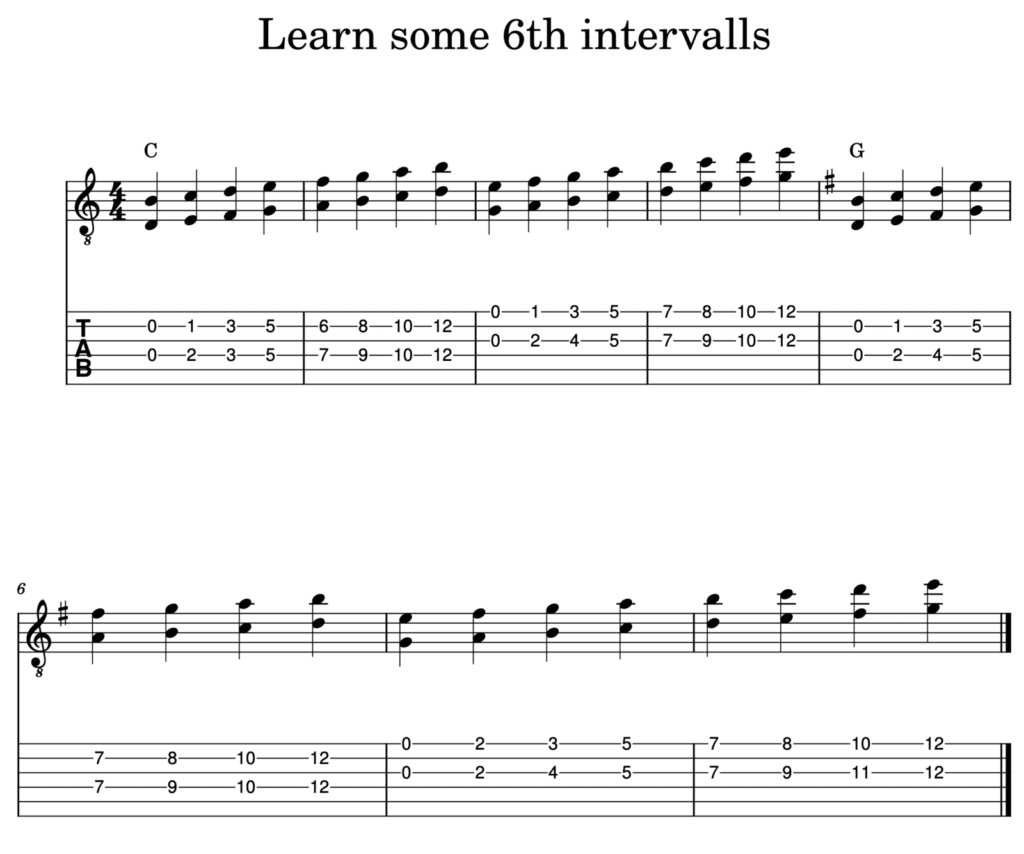
Learn 6th intervalls
We start by learning 6th intervalls on two string sets in the key of C-Major and G-Major .
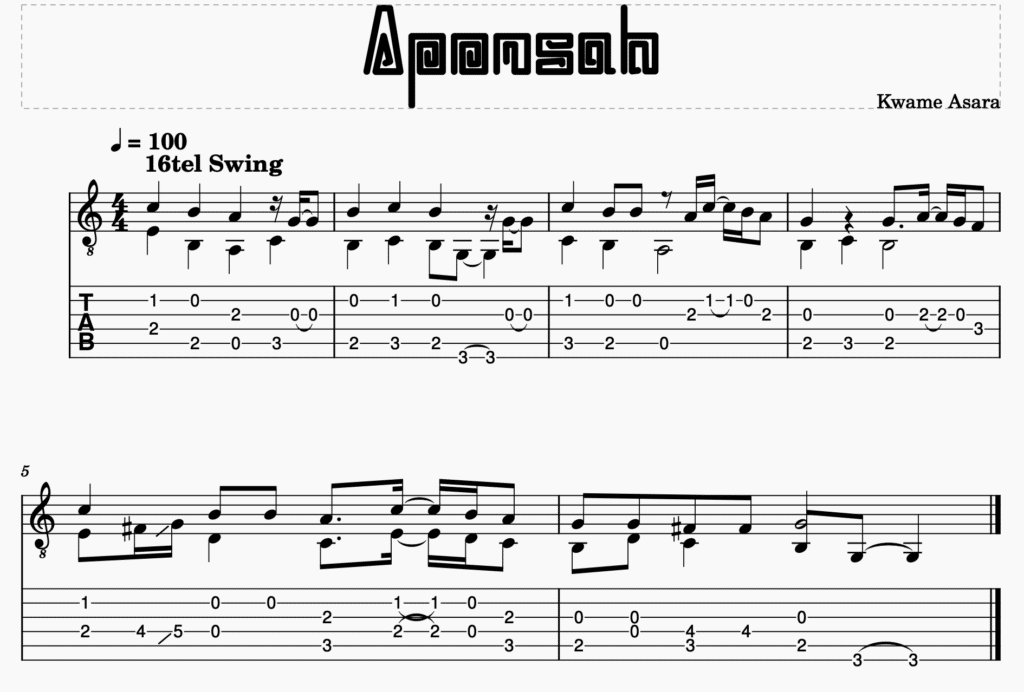
Aponsah
“YAA Aponsah” by Kwame Asare is very catchy and accessible to Western ears. It’s a great starting point for getting into Palmwine music.
An important element of African—and also Caribbean—music is the use of a continuous clave pattern, which provides the fundamental pulse and holds the band together.
The clave originally refers to two wooden sticks that are struck together, but it also describes the underlying rhythmic pattern of a piece. In this case: short, short, long (quarter note, quarter note, half note).
Let’s check my version of Aponsah. I tried to imitate the original as close as possible for you
African Swing
In the following piece, we get a clear view where the Swing-Feel of Jazz-music came from.
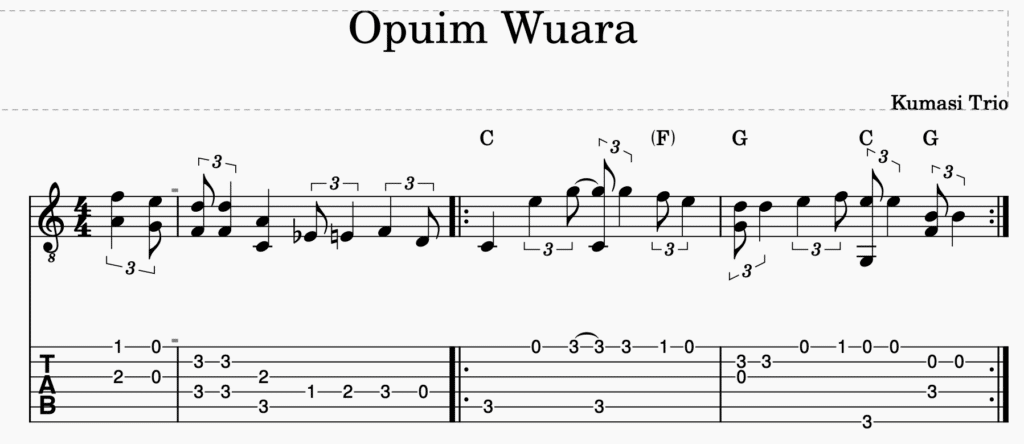
While in Amponsah we feel a more subtle sixteenth-note swing, the next piece brings out a much stronger ternary feel. Opuhim Wuara by the Kumasi Trio is essentially in a 12/8 time signature.
Through the constant interplay between long–short and short–long patterns, along with the use of tied notes, a very distinctive rhythmic feel emerges. It reflects the deeply rooted practice of ternary rhythms (that is, thinking and feeling in groups of three) in African music—something that continues to shape and inspire styles like blues, jazz, soul, and R&B to this day.
Checkbox
- Palmwine music from West Africa is characterized by pervasive ternary rhythms (a 12/8 feel across increasingly smaller rhythmic subdivisions).
- The use of thirds and sixth intervals plays a major role.
- On the guitar, players typically use the thumb and index finger for the picking hand—this allows for additional intervals and a strong, independent bass line that works in a complementary, syncopated relationship with the melody played by the finger voice, similar to the well-known Travis or Chet Atkins picking styles in country music.
- It is played on steel-string (acoustic) or classical guitars. Open keys such as C major are popular and are often adjusted with a capo if needed.
Karibik and Cuban influences
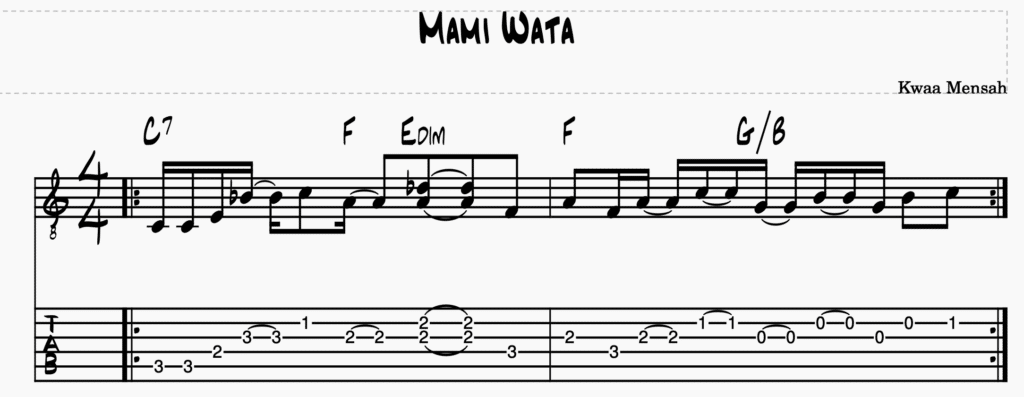
In Mami Wata, you can clearly hear—at least in my view—the Latin American and Caribbean influences in Palmwine music. There is a distinct clave pattern and a straighter rhythm that moves away from the African swing of the 12/8 feel. It’s a piece that could just as easily appear, in a similar form, within the South American musical tradition.
Mami Wata
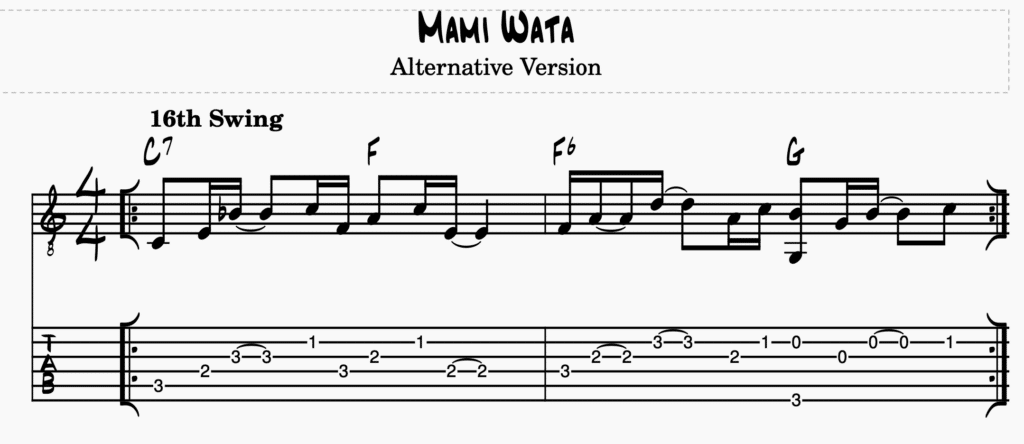
I discovered that many contemporary west-african musician are playing Mami Wata in a more modern style. The Guitar Player George Spratz presented this Version of the Riff.
Alternative Version by George Spratz
More Information about George Spratz: https://www.youtube.com/user/georgespratz
Extreme Polyrythmn
Crossing the clave
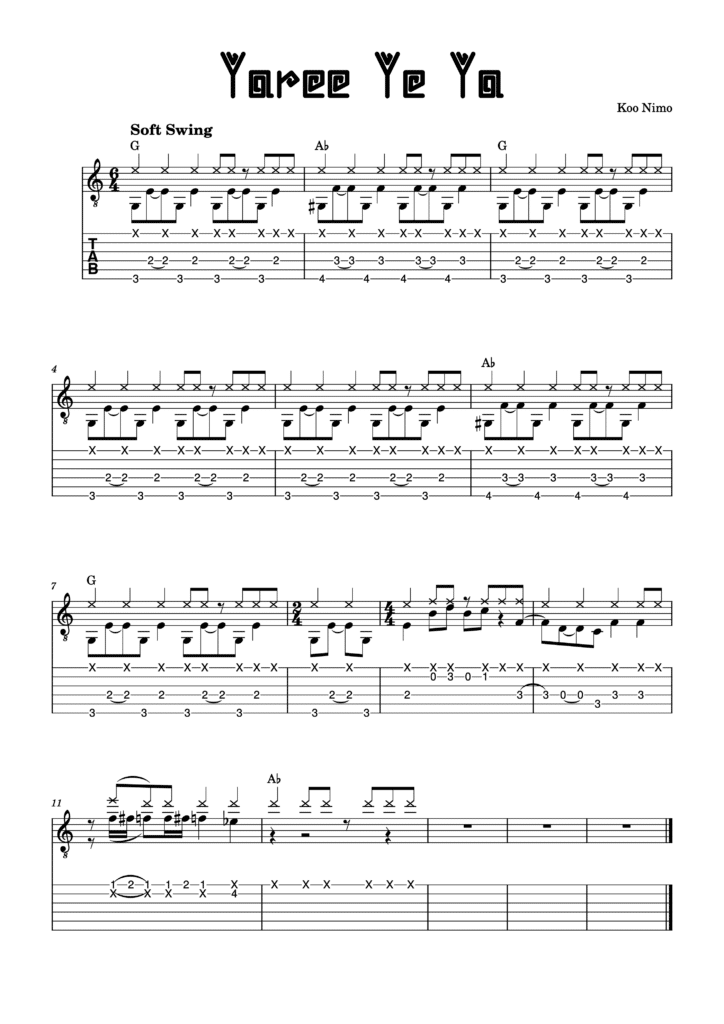
Yaree Ye Ya by Koo Nimo begins in a catchy and accessible way. A clear clave pattern sets in, followed by a guitar figure outlining the chords G and Ab. Suddenly there is a stop—almost like a pickup—and for Western ears, the structure quickly becomes difficult to follow.
Even after listening many times, I also quickly reach the limits of what I can meaningfully comprehend musically. It feels as if the individual voices are interacting in extremely offset polyrhythms. Yet Koo Nimo naturally and effortlessly re-enters on the “1+” of the clave with his opening lyrics, as if nothing had happened.
The answer to this phenomenon actually lies right at the beginning of the piece. The clave starts, and the music effectively begins on the third beat — yet it immediately feels like the first beat of the piece (and is perceived that way). To return to the original clave alignment, a 2/4 bar is inserted while the clave continues playing uninterrupted. Through this trick, the clave and the band realign with the original counting at the start of the piece.
This technique is also called “clave crossing.” It gives the music an incredible sense of density and complexity.
For me, it is both admirable and still a complete mystery how one can navigate such a free form while staying anchored to a continuous clave pattern. In the following, I attempt to do justice to this piece with a short excerpt of notation.
Yaree Ye Ya
Use it in your Playing
Now it’s time to find ways to get the influences of West-Africa in your playing.
What helps me is to write my own little compositions. It helps to take a look in slow motion, to find what you like and what you don’t like.
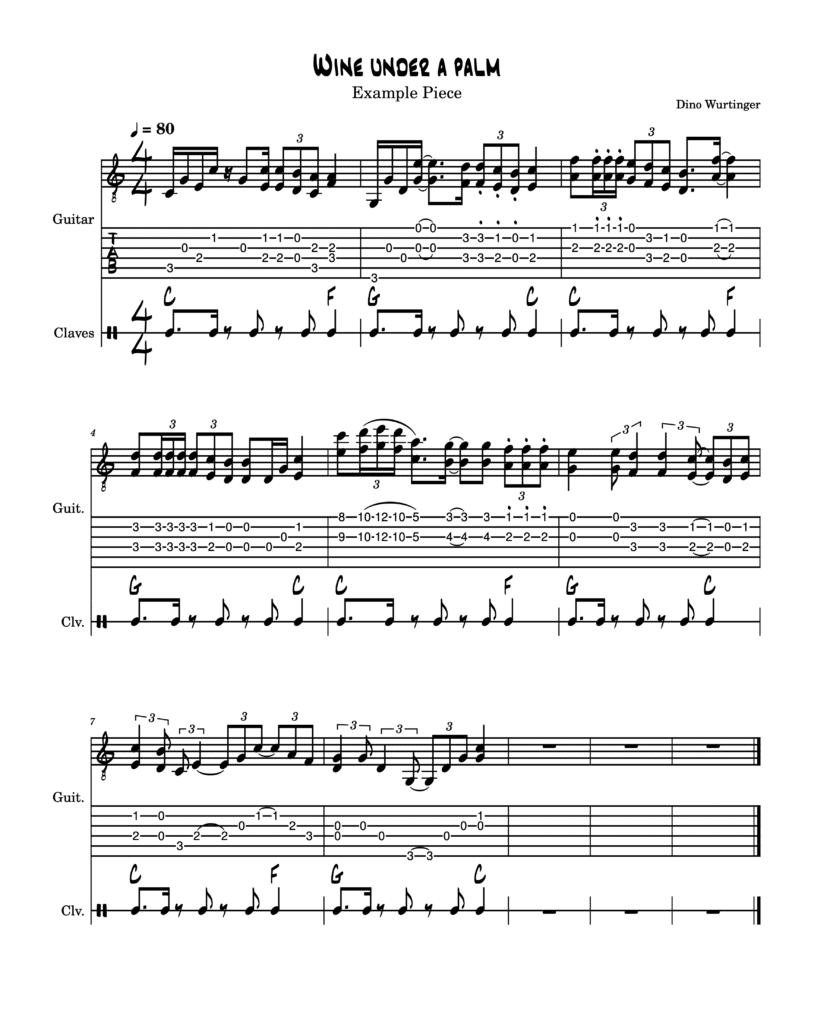
The piece „Wine under a palm“ tries to show many of the ideas we learned from the music examples of Ghana and West-Africa.
- Using clave pattern
- Strong rhythmic ideas with mixing straight and triplet feelings
- Using 6th intervalls
- Using staccato technique
Wine under a palm
Improvisation
If you’d like, you can try improvising over the following backing track in the style of the ideas we’ve learned. If you want to learn more about improvising over chord progressions, I especially recommend my Oldtime-Swing course at this point. At the beginning of this course, I go into detail about using triads and how we can derive suitable pentatonic scales from them.
Above all, African music is pure rhythm. Try especially to incorporate our rhythmic ideas. If you want to achieve more harmonic structure, it’s advisable to explore triads and their pentatonic patterns.